I am incredibly excited to share that I am a part of this Residency!
This program is uniquely designed for artist-parents and primary caregivers, providing a flexible digital space to develop our practices while navigating the realities of caregiving. Over the next few weeks, I’ll be participating in workshops, connecting with incredible peer-artists, and receiving mentorship to explore the beautiful, complex intersection of art and care.
A massive thank you to the organizers and mentors for creating a space that truly understands and accommodates the needs of parent-artists. Stay tuned for updates on my journey and the work I’ll be developing!
There will be an exhibition at the Zentrum für Kunst in Bremen, Germany.
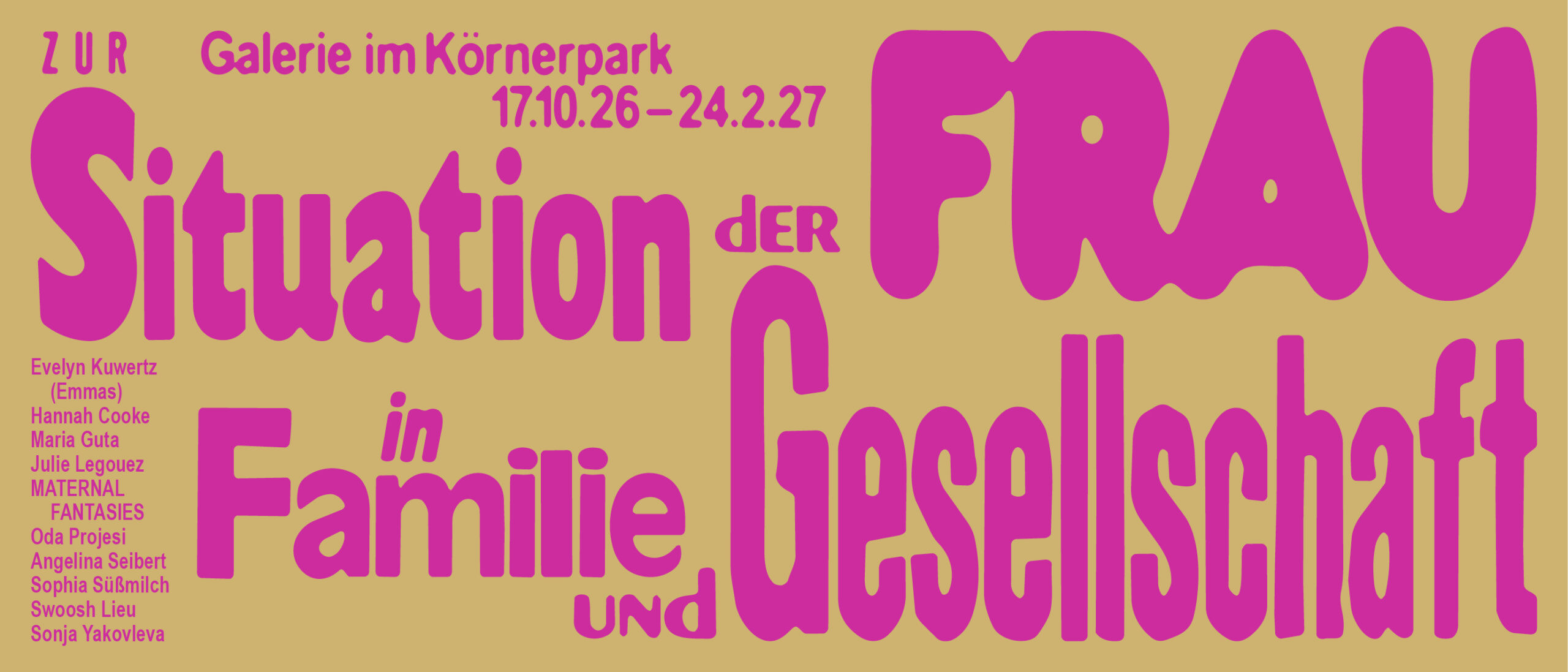
In 1973, art students Evelyn Kuwertz, Brigitte Mauch, and Antonia Wernery created a life-size environment as part of their thesis at the Berlin University of the Arts, titled “On the Situation of Women in Family and Society.” They examined media portrayals of women in the 1960s and 1970s, revealing how women were reduced to the roles of mother, housewife, and sex object—culminating in the “final product wife.”
Shortly before the exhibition opening, it was censored due to “moral concerns.” Since then, the work has not been on display again in Berlin. Galerie im Körnerpark is now exhibiting the surviving parts of the environment for the first time in fifty years, accompanied by sketches and archival materials from Kuwertz’s private collection, contextualizing the work as an important document of feminist art history in West Berlin.
The exhibition initiates a dialogue with nine contemporary artistic perspectives and, fifty years later, raises once again the question: What is the situation of women in family and society today? Right-wing movements and anti-feminism have risen worldwide, conservative gender roles are experiencing a resurgence, and the achievements of the #MeToo era are severely under pressure. The invited artists take up the topics of the “Emmas”—care work, media’s constructions of femininity, violence against women, and feminist image production—tracing continuities and ruptures.
The exhibition is supported by the Capital Cultural Fund.
Curated by Nina Marlene Kraus Curatorial Assistant Johanna Engemann
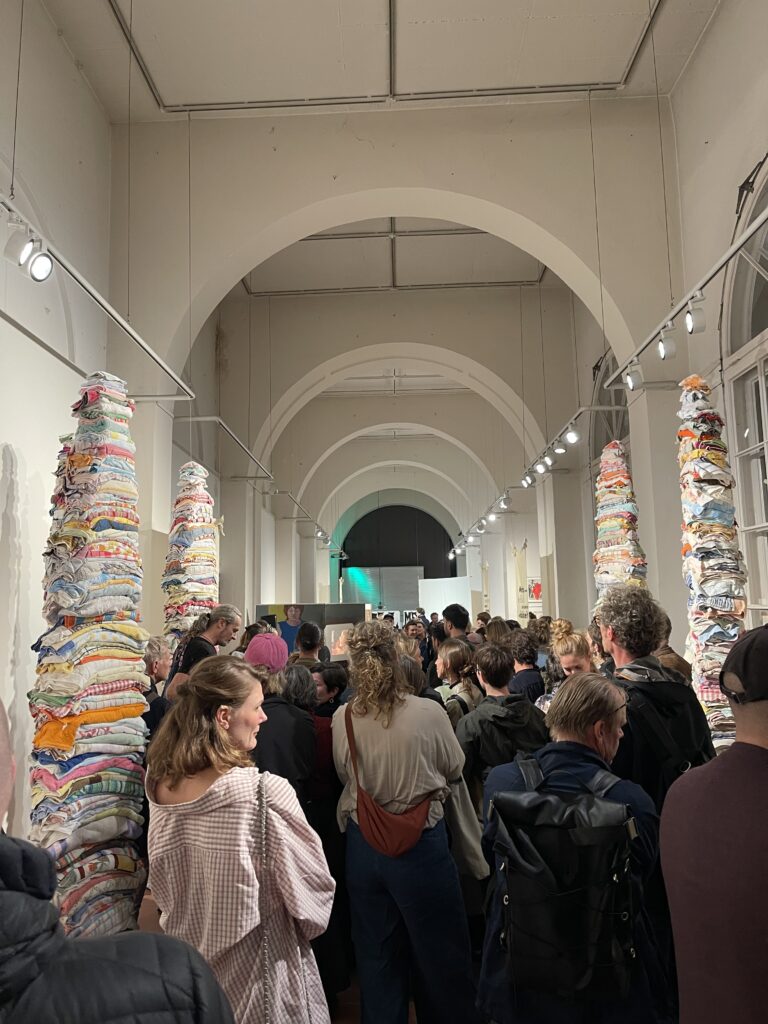
It was a pleasure to be invited to participate in this amazing exhibition! Below is a photo from the opening and a pdf with more information about the exhibition that you can scroll down to also see dates for upcoming events associated with the exhibition. For instance I will be having a discussion with Dr. Sascia Bailer about Care-work in the arts. I will also include some more glimpses into the opening ceremony and the other works from the artists presented there as a link provided down below.
The house I share with my husband and our daughters stands dismantled in the room. Its façade has been reassembled like billboards, its fences broken and scattered across the exhibition – boundaries that have been dissolved, an ambivalence that cuts both ways: liberation or punishment, depending on which side one stands. Through the windows, a film transports viewers inside, from where they watch me cleaning the panes – the invisible labor that keeps the surface clear. The cleaner the glass, the less one sees the hands that cleaned it.
In an era in which everyone films, shares, and documents, the line between "mine" and "ours" – between the private and the public – is no longer a fixed line, but a continuous negotiation.
Exhibition view of My house ( our house) 2026.Inkjet on Kappa boards, Steel, Ceramic, Video on Displays, Palletes.Exhibition view of My house ( our house) 2026.Inkjet on Kappa boards, Steel, Ceramic, Video on Displays, PalletesDetail of My house ( our house) 2026Detail My house ( our house), 2026.Detail of My house ( our house), 2026.Zaun, 2026. Wooden found object.A place I have never been, 2025. Etching.Untitled ( collage with child), 2026.Exhibition view, Won’t you be my neighbor? 2026Exhibition view Won’t you be my neighbor?
For this exhibition, I pulled together three works.
Row, 2026
Exhibition view of Row, 2026, Steel pipe and rocks with two channel video / photo taken by: Victoria Gentsch, material matters.
Row, Row, Row your boat gently down the stream, merrily, merrily,
merrily, life is but a dream is being sung and heard around the room
from the displays that are showing videos of myself in my bath robe, in
my kitchen pretending to paddle on a canoe with my broom in hand
making paddle motions while singing out to the camera- this popular
childrens song. The video on both displays are the same footage, played
at different sequences, thus creating a canon. The scenes are inserted
in the pipe creating references to pipe dreams, when in reality I have to
tend to my responsibilities, living far from the option of going on a boat
ride.
2. Build you up/ tear you down, 2026
Exhibition view of Build you up/ tear you down. 2 steel pipes, lights, moss, cables. 2026 / Photo taken by: Victoria Gentsch, material matters.Exhibition view of Build you up/ tear you down. 2 steel pipes, lights, moss, cables. 2026 / Photo taken by: Victoria Gentsch, material matters.Detail of Build you up/ tear you down. 2 steel pipes, lights, moss, cables. 2026 / Photo taken by: Victoria Gentsch, material matters.
3. Taucherbrille ,2026
Exhibition view of Taucherbrille, 2026. Wooden panel, glazed ceramic, and video on display./ Photo taken by Victoria Gentsch, material matters.
Inside a snorkeling mask, the viewer looks into my
fish tank that I filmed: blurred fish drift across the frame
while, behind them, a sudden clear image shows me cleaning
the glass. My work focuses on acts of cleaning—layered
scenes that ultimately return to a single, persistent
“Die Dresdner Stiftung Kunst & Kultur der Ostsächsischen Sparkasse Dresden vergibt, gemeinsam mit dem Programm »Deutschlandstipendium«, jährlich zwei Projektstipendien an herausragende Meisterschülerinnen und Meisterschüler der Hochschule für Bildende Künste Dresden. Die Ausgezeichneten des Jahres 2025/2026 sind Martin Bertelmann und Angelina Seibert. Im Anschluss an ihre Förderzeit präsentieren sie aktuelle Werke im Projektraum der Städtischen Galerie Dresden.”
I have shown new works Payment unsuccessful and Handles. M26 in the Kunsthalle Oktogon, University for Visual Arts Dresden, Post Graduate Degree exhibition.
Payment unsuccessful, 2026 is an installation made up of wood, ceramic, brick, mirror
it is about 90cm x 215cm and 100 cm x 250 cm big.
This installation consists of two freestanding walls facing each other in the middle of the room. One side is covered entirely in mirrors, with a sink and exposed pipes that stop abruptly. The other wall has handmade tiles with text that only becomes readable through the mirror.
When you step in front of the mirror, you become part of the work. You’re not just looking at it—you’re inside it.
The work comes from an earlier idea I’ve been thinking about: that responsibility is the ability to respond. For me, that often shows up in very ordinary moments—like standing in front of a mirror in the morning
A lot of my own anxiety is tied to financial insecurity—the fear of not being able to afford things, or keep up
But I don’t think this is just personal. These kinds of worries sit in the background for many people. So when viewers see themselves in the mirror, they’re also confronted with their own version of that.
The text ‘payment unsuccessful’ is written backwards—it only becomes legible through reflection. So the message only appears when you face yourself. In that sense, the work asks: what are we actually able to respond to, and what feels out of our control?
This work is about what happens when you’re forced to face yourself—and the quiet anxieties you carry with you, especially around survival and responsibility.
When I met my husband, it was in the age of the small Nokia, just right before smart phones became a thing everyone had. The phone got lost and broken, but resurfaced after a decade. These are the messages I wanted to keep around and not have get lost again. When we first met, exchanging these texts, can now potentially become the nexts artifacts of the next millennia.
In this 15 minute performance, I recite a divine feminine affirmations meditation while folding laundry..
I am a sacred being.
I am tuned into my sensuality.
I love my Body.
More and More I exude beauty and grace.
I am a sacred being. I enjoy my sexuality. I fall inlove with my beauty. I am fully embodied, I relish in my sexual feelings. I am a sacred being. I embrace my emotions with love. I am open to intimacy and sacred touch. I honor my desires in a nurturing way. I feel pleasure in my body. I am receptive. My feminine nature enjoys movement and flow. I am a sacred being. I connect with others with ease now. I feel safe being connected. I honor my sexual desires. Like water I am powerful, fluid and flexible. I am a sexual being. I allow myself to enjoy the sweetness of life. As a woman I have incredible attracting powers. I feel my desires now, I am aware. I am a sacred being. I admire my favorite places of my body. It is safe for me to feel all of my feelings. In relationships I maintain my own goddess center. I feel empowered in my feminine nature. Healing energy flows through my womb space. I am a sacred being.
I recite the affirmations until I am no longer visible, but you can still hear me
During my final semester at the University of Visual Arts Dresden, I participated in a workshop focusing on archival practices and artistic approaches to the archive. The resulting catalogue, presented below, includes descriptions of the works by all participating students. I was also involved in the design and visual development of the publication.
The downloadable PDF contains the complete catalogue.
Below, you will find the video work I produced for the exhibition: These Days Are Gone (2025).
2022, Towels and metal, five times ca. 350 cm x 50cm
The towers of neatly folded towels, burp cloths and flannels are stacked metres high. The bright colours of the washcloths can in no way conceal the nerve-racking thought of never- ending housework. In her artistic work, Angelina Seibert deals with her personal role as a mother of three children. The challenge of running a household as a mother of three and at the same time, working as an independent artist, opens up a broad spectrum of experiences of adversity, barriers and pol- itics for Angelina Seibert, from which she draws upon artisti- cally. With multimedia works and performances, in which she often works with the motif of repetition, the exercise of main- tenance work or the involvement of her family as actors, she makes the realities of housework, care work and education visible: What does it mean to be a good housewife, mother and at the same time a good artist? What expectations must you live up to? What protocol does one have to follow? Which of our own patterns and traumas accompany us and how are these passed on to the next generation?